Folks, my blog is no longer hosted by WordPress. It is now at http://www.mitchellkphotos.com/blog/.
Please redirect your RSS feeds, links and whatever else.
See you on my new blog. 🙂
Folks, my blog is no longer hosted by WordPress. It is now at http://www.mitchellkphotos.com/blog/.
Please redirect your RSS feeds, links and whatever else.
See you on my new blog. 🙂

Hello friends! I have finally updated my website and blog! I had a lot of help from my wonderful and poor father, poor because I kinda forced him to help me out with the coding side of things during free time from his already stressful job. So thanks Dad, but don’t relax too much just yet, there is still work for you to be done. 🙂

As you can see from the screen captures, it is not a major overhaul, but it is a noticeable change. The main reason that spurred the change was the fact that with more and more people having larger monitors to see photographs, I felt that the size of the images I had online was much too small. Now the photos will fit onto the screen of an iPad and will also be large enough to appreciate on a larger monitor. This could of course mean that more people will steal my images (the other day I was told via email that someone had actually used my photograph to enter a contest). My answer to this is – I don’t really give a crap. Not that much at least. But if someone will try to make money from my images, that is another story. I will come after you! 🙂
I took some inspiration from some photographers whose work and design taste I respect and kinda mixed everything together into something that I feel reflects who I am. Some of these include – Amy Vitale, Randy Olson and David duChemin.
I have created an archive of some of my images on “Photoshelter”. There still isn’t all that much up there and key-wording the images will be a major pain in the butt, however, anyone interested in seeing more of my work can visit the “Archive” section in the navigation bar.
Now about the new blog. Anyone who had this Blog page book-marked, linked to or subscribed to, please re-direct to http://www.mitchellkphotos.com/blog/ that’s the new home of the blog from now on. I’ll be adding a more convenient subscribe by email feature in the near future. Keep an eye out for that, as competitions and special deals will be sent to those who subscribe by email.
My website, as it has been will remain at http://www.mitchellkphotos.com. Please feel free to check it out and tell me what you think on the new blog.
I’m in Manila waiting for a friend with whom I will make a trip North into the mountains of a region called Luzon. I’ve taken a few shots here and I’ll have a couple posted in the next post on the new blog.

I’ve well and truly settled back into the “other” world in which I sometimes live. That is the world of editing and post processing images, staring at the computer for over 10 hours a day and generally not getting out much, except to walk my dog, to whom I’m thankful for giving me a reason to do at least that much.
Thankfully I will be hitting the road in a couple of weeks. A few twists and turns have led me to decide to travel to the Philippines. If all goes right, I’m supposed to do a seminar (or a few of them) on travel photography at one or maybe even a few photo clubs there. Originally I planned for this trip to last a couple of weeks en-route to India, but as I’m not easily satisfied with a short amount of time at a destination and love to “dig” deeper, as much below the surface as I can, I’ll most likely end up spending about four months exploring the country on a motorcycle (again if everything goes right).
My recent trip to Vanuatu reminded me of just how exhilarating it is to explore “unchartered” territory. I hope the Philippines will provide more of this exhilaration. There’s also a part of me which wants a new challenge, which wants to grow and to evolve as a photographer and though India certainly isn’t short of opportunities for growth in that sense, I feel that over the years it’s become too much of a comfort zone, it’s time to see what else is out there, at least for now.
So, anyone in the Philippines who reads this blog, feel free to contact me here or via the email (on the website) and perhaps we can meet up, hang out and pick each other’s brains.
I’ve been back in Sydney for some time now. With all the trips back and forth over the years, it is no longer strange to be jump between these worlds, which are so different from each other.
I keep thinking of Vanuatu. In particular I’ve been thinking of the big question of development there, the tourism development or whatever development for that matter. As I had mentioned in past posts I photographed some people and places in order to help promote a couple of the lesser known regions to tourists, in a sense to develop tourism there.
Before I left Vanuatu I managed to get a photo story into Air Vanuatu’s inflight magazine “Island Spirit”. Besides being on the airplanes the publication can be found at every single hotel and guesthouse around the bigger towns of the country. That will be a good little push for George and South West Bay, hopefully. But I keep thinking about where the potential development, where all that interaction with tourists and all the building of new guesthouses, new facilities will lead. Will it really be positive, as I perhaps naively hope? To be totally honest, the country for most part is perfect, or rather it would be perfect, if there weren’t these conflicting views that the modern, developed, “white-man” world is bringing.
Prior to leaving the island of Santo I met an interesting young anthropologist. He had a very cynical view of where things might head. History, he said showed that development had never been good for societies similar to that of Vanuatu. Urban drift, alcohol consumption, increased crime rates – these were all byproducts of the so called modernization. I could only imagine in horror how the wonderful places I’d been to might be affected if things don’t go quite as planned.
In some ways I agree with the anthropologist, but another part of me feels that at times the thinking and reasoning of academics is quite unrealistic. He suggested that it would be better to keep things as they are, the locals don’t need all this crap that we have, they’ve been living for hundreds of years without it. Agreed. But then I had been in Vanuatu long enough and had spoken to enough locals who lived in between these two worlds – the modern and the ancient and they were desperate to see more of our world, to do those things that the “white-men” get to do. Young, a good friend I made on the very remote Rah Island had worked in Port Vila – the capital of Vanuatu for a few years, he acquired a taste for TV and he desperately wanted to see different parts of the world. When I told him that what they have is special, that they don’t need to seek happiness elsewhere or to change things at home, he replied “Yes, but I want to see why it’s so special here. I want to see other countries and to be able to decide for myself.” Fair enough, I think.
He also said something that was very simple and ultimately really insightful. “The white people used to come here and say – you must all change, become modern, wear clothes, stop your rituals, worship Jesus. Now they come and say – go back to the ways of the past, become more traditional, we want to see more of your culture. What are we to do? We are very confused now! What is it exactly that you want from us?” What Young said reflects the way many young Ni Vanutu people from the islands must feel. He’s confused and somewhat frustrated, and; who’s to say that development will answer his questions? Who’s to say that Port Villa isn’t going to become the next Port Moresby (considered by many one of the least livable cities in the world)? If Port Vila is indeed heading that way, tourism will be a pretty small concern in comparison the multitude of serious problems that will arise.
And so I keep asking myself. On the one hand; what is the point of development in a place like Vanuatu? On the other hand; what is the point of preserving things, if all the young locals want to do is watch “Rambo” and “Lost”? Can they really be blamed? Are they lesser people than us that we should decide what’s good for them and what’s not? And then ultimately I ask myself; what is the point of doing what I started? Meaning helping the locals attract more tourists to their areas and in effect “develop” them.
I guess I find comfort in one story that was told to me by an American NGO worker who I met along my journey. He had the same dilemma as me at the beginning of what has now been a four year commitment to developing medical centers around the country. He once asked a more experienced NGO worker: “What is the point of what we’re doing? These people survived for so long without us. Are we just f–cking up their world, by pushing them forward and changing their ideology with what we are doing?” To this he got the following reply. “Development is inevitable, you aren’t going to be able to stop things or go back to the stone age, but things can move forward in different ways. Development can put everything on its head and basically destroy an entire society or it can be brought on more gently, more gradually and that will lead to a much smoother transition and a less disastrous result. You’re one of the people who’s trying to achieve the latter and that is a good thing.”
I hope that my involvement would put me in the latter category too. I should also mention that in Vanuatu development has so far only been “passed down” to the locals from the foreigners that have invested in the country (or before colonized it). The foreigners are in power, while the locals are mostly picking up the crumbs of the benefits of this “development” and they are often having to do this away from home, because development is centered only around the capital and the island of Espiritu Santo.
Tourism outside of the main islands, would actually put a lot of people in an entirely different position. They would not have to go outside to earn their money, they would become business owners (some already are), they would be empowered to make their decisions and whether that would be to go back to the ways of the past or to watch DVDs well, that’s a decision which I believe they deserve to make.
Well, that’s about it for this post. I needed to get those thoughts out of the system. I invite anyone who has read this post in full to share their opinions; whether cynical or not I am very interested to read what other people are thinking. What have some of you learned from your journeys or perhaps from living in countries which have seen rapid development recently?
You might not hear all that much from me in the coming weeks (though I’ll try). I’ve been busy archiving my collection with the aim of putting up on Photoshelter. I’ll also be slightly redesigning the website and the blog. Good changes are on their way. Stay tuned.
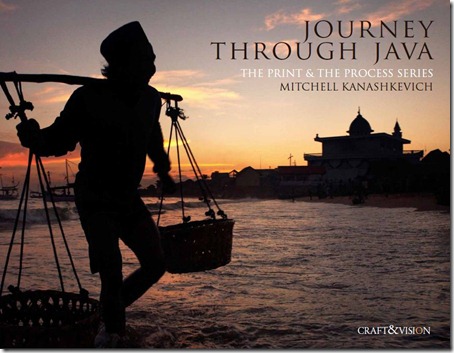
Hello good people of the Cyberworld! I have a new eBook out! As you probably gathered from the image above, it’s called “Journey through Java”. This one is a collaboration with David duChemin’s “Craft and Vision” team and it is a part of their very popular “Print and Process” series. Basically, it’s my photos and words, their structure and design.
Those of you who have been following my blog for some time are aware that I have known this duChemin fellow for a while. I think quite highly of the man, so when David approached me about doing one or possibly even a few eBooks for the “Print and Process” series, I said – “Sure thing mate!”
What really excites me about this eBook is the fact that the structure of it allowed me to focus on a specific stretch of time during my photographic journeys and as a result I was able to delve deeper into my photographic process than ever before. The eBook is fairly personal, but at the same time, the knowledge one should come away with is applicable on a very wide scale.
There’s talk about the equipment used, the technical aspects (every image has the Exif data provided) as well as composition and light. These things are all discussed in a very practical sense, as they relate to the images included in the eBook. There is a somewhat philosophical side to what I’ve written too. In this eBook I really wanted to touch on what makes a photograph more than a snapshot or an overused cliché and so I’ve devoted a whole section to the discussion of what it means to create shots that are deep, original and express what the photographer feels to the fullest.

Who is this eBook for? It is for anyone who enjoys my photography and wants to know how I go about creating my work. I do however feel that the eBook will be particularly useful for the serious amateurs who want their photos to be more than “pretty pictures” as well as those thinking of doing travel and documentary photography for a living.
The really good part for all of you strapped for cash is – it’s only $5! And if you use the promotional code JAVA4 as you check out from Paypal, you’ll get it for $4 (offer expires 11:59pm PST October 3, 2010).
To purchaseor for more info, head over to the “Craft and Vision” site HERE or click the cover shot at the top. As always, your support is really appreciated!
I’m still in Port Villa as I write this, but heading home soon. More photos and hopefully some videos to come soon.
As I mentioned in my last post about Bob, my photography to assist tourism development continued in Rah Lava and to a lesser extent the bigger, neighbouring Mota Lava. The two islands belong to the very remote Banks group, they’re pretty much in the middle of nowhere, surrounded by endless stretches of the Pacific ocean. If you’re looking for a place to completely escape the busy, modern world and you like the sea, this is the place to escape to.
I’ve seen a lot of beautiful places over my travels and it’s not that easy to impress me anymore, however, I am a sucker for sea and mountains and whenever I find a place with both, well, I instantly fall in love. It’s not that I like to climb mountains, it’s that I love the sight of mountains rising over the sea. In my books it’s hard to come up with a better backdrop to a photograph than something like that. The beach and the lagoon at Rah Lava offered me those very kinds of backdrops, along with some fairly thick, lush greenery in the island’s interior. Besides the great scenery Rah Lava had something else to offer and that was some incredibly amazing (usually very expensive, but not here) seafood – I managed to live out my dream of eating lobster for breakfast, lunch and dinner (ok, I’m sick, I know, but it’s so tasty). Of course, to top it all off, as elsewhere in Vanuatu the people were absolutely wonderful. Quite naturally, I had to stay a while in Rah and I did, it was my longest stay in Vanuatu so far – two and a half weeks.
The reason I came to Rah was because George Thompson, the man I was helping out in South West Bay advised me to make the journey there and help out a man (in the same way – take photos for marketing) by the name of Luke Dini or Father Luke as he introduces himself (he’s a retired pastor). Both George and Father Luke were members of Vanuatu’s bungalow association, in fact they were probably the first two men to join a few decades back. The association was meant to set some sorts of standards for bungalows as well as service in those bungalows. The government was meant to help out and direct tourists to those places which were a part of the association.
It appears however that whatever project the government of Vanuatu undertakes, that project is destined for not fulfilling its potential and that has certainly been the case here. Father Luke opened his Bungalow in the seventies and he waited for fifteen years for the first foreign visitors, who happened to be a group of New Zeland Yachties needing to stay on land for just one night. After that there were no more tourists for another five years, but for whatever reason Father Luke didn’t abandon his idea of running a bungalow.
For years the place would receive just a handful of visitors a year, most of them – discount-seeking government workers who found the bungalow through the association (they seem to be the only people who turn to the association to find accommodation). From my understanding, the income was meagre, but Father Luke understood; for a small community like that of Rah Island, tourism was the only kind of business that would empower the locals and give them a chance to earn a decent enough income. Perhaps more importantly, it could keep the youth closer to home and this is a big thing, considering that many young, ambitious Ni-Vans leave remote places like Rah in search of jobs on the more developed Efate (where the capital Vila is) and Santo (where the second capital Luganville is located). Most often the youth come back, disillusioned, disappointed in their experiences in the world outside. The money they earn on the more developed islands is small in comparison to their sky-high expenses of living away form home. Things like food and accommodation are free for them, while they stay close to home in the huts that they build, near their gardens and the sea in which they know every fishing spot. In the outside world everything has a price tag and because of foreign investment and influence, things are pretty much out of reach for the regular citizen of Vanuatu.
When the youth come back to places like Rah after a disappointing tenure in the capital, they find themselves in an unusual situation. Having been exposed to the world of televisions, DVDs and night clubs they can’t look at life in a quiet island paradise without modern facilities in quite the same way. Sometimes they come back with new skills, which they can’t use because there are no industries of any sort. They’re left in-between two words, confused, a little frustrated and dreaming of what things would be like if their fortunes turned.
Father Luke had a vision, he felt that the presence of tourists on Rah could contribute to the entire community. Starting from the canoe-taxi across the lagoon from “mainland” Mota Lava, which every visitor must take to get to the bungalow, to the fishermen, lobster and coconut crab catchers who sold their catch to his the restaurant, to the traditional dance performers and so on. Everyone would benefit, everyone interested would have a chance to earn an income which was while fairly small, went a long way on an island like Rah. I was surprised that Father Luke was able to see such a big picture, this was very unusual for a man from a remote, forgotten island in the Pacific.
It turned out that Father Luke, besides being a Church pastor in the past, was a politician in the more distant past. In fact he was second in charge of all of Vanuatu during the colonial years and secretary to the president, once Vanuatu gained its independence. I was pleasantly surprised that Father Luke resigned from his high position because he strongly opposed the increasing corruption in the higher ranks of the government. It was then only at the beginning of its growth, these days the corruption in Vanuatu is legendary.
“My wife liked living the lavish lifestyle, having chauffers and eating in restaurants, so she didn’t want me to quit. I told her this; we can continue like that, but in a few years you will lose your husband, for I cannot stand living a lie, I’ll probably die from stress, from a heart-attack or something like that. I want to keep my dignity and to be able to look in the eyes of the people back home on Rah.” These were Father Luke’s words, to which his wife replied – “Let’s go home” meaning their modest house on Rah Island.
And so in some ways Father Luke is similar to George Thompson. He is a man who puts dignity and community above money and easy life. Thankfully, unlike George, after years and years of struggle things have taken turn for the better for Father Luke’s bungalows. They probably get close to thirty visitors a year on Rah Island and although the number does not seem impressive, it is when you consider the beginnings.
Since this is a photography and travel blog, I feel obliged to tell the readers about Rah Island as a travel destination, not only a photography destination. As I mentioned, it’s the ideal place to escape the hustle and bustle of the modern, developed world. It’s still not luxurious comfort living, but there is solar power, a shower and flush toilets – things that are not so common in the outer islands of Vanuatu. Father Luke’s bungalows are pretty cheap too, not South East Asia cheap, but fairly cheap by other standards. It’s about US$30 per person per day and that includes food, which after my recommendation will include more fresh fish and the possibility to eat lobster and coconut crab whenever your heart desires.
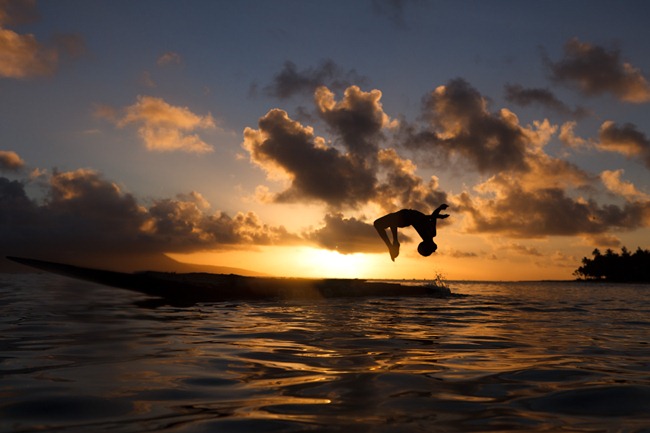
Ok, that’s enough of that. Let’s get to the photographs. The one above is of a local kid doing a back-flip from a canoe in the lagoon.
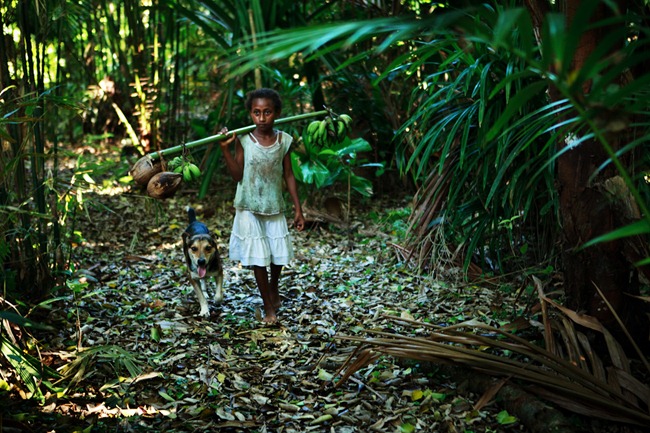
Saron returning from her family’s garden with the village dog. Vanuatu is one of the greatest agricultural societies on the planet, every family has a garden and every village family lives from one. The gardens are usually located somewhere in the bush and almost daily a family member will venture out there in order to tend to the crops or to bring some produce back home.
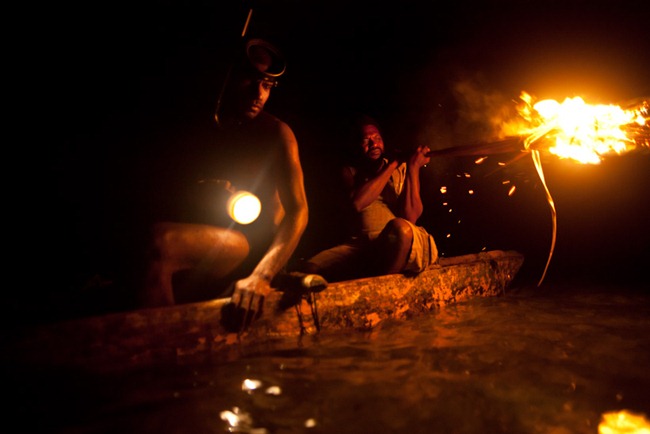
Silas and Young lobster hunting. The men look for familiar spots where they’re likely to find the crustaceans. The easiest time to catch them is during the moment of feeding, which lasts for approximately half an hour in the evening.
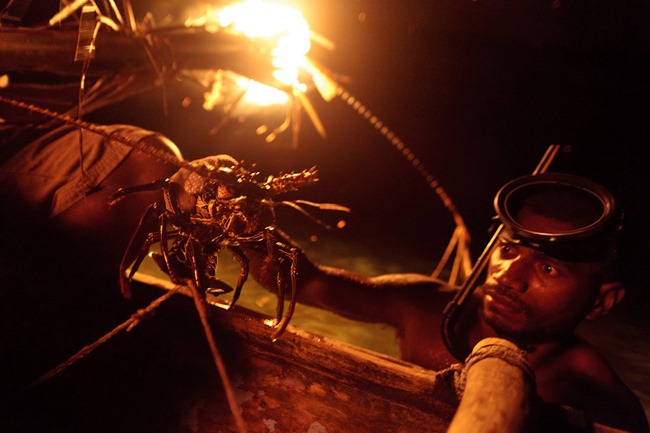
Silas putting one of the lobsters into the boat.
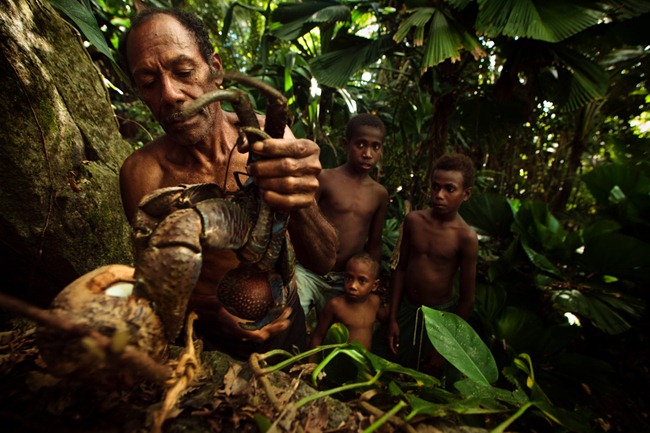
While on the subject of edible crustaceans, here’s another one – the legendary coconut crab. Near extinction in most of the world, the coconut crab is in abundance in lots of the Torba province, of which Rah and Mota Lava are a part. As you can see they grow pretty big, in fact according to Wikipedia, it is the largest-living arthropod on the planet. Those claws mean business too, Joseph is very experienced at catching and handling the creatures. Here some village youngsters watch him as he separates the coconut crab from his bate – the coconut.
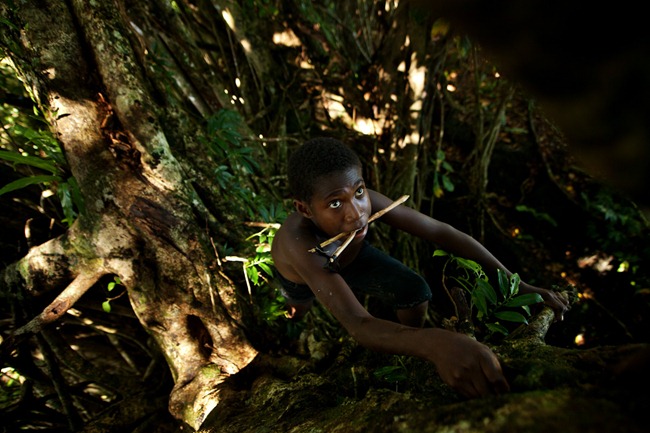
As I mentioned in the last post, the men of Vanuatu are generally pretty amazing tree-climbers. By the time they’re teenagers they are strong enough to climb some crazy-big trees. David is one such teenager. As many other boys his age he climbs up trees to hunt (with a sling-shot) small birds and flying foxes, a delicacy in many parts of Vanatu.
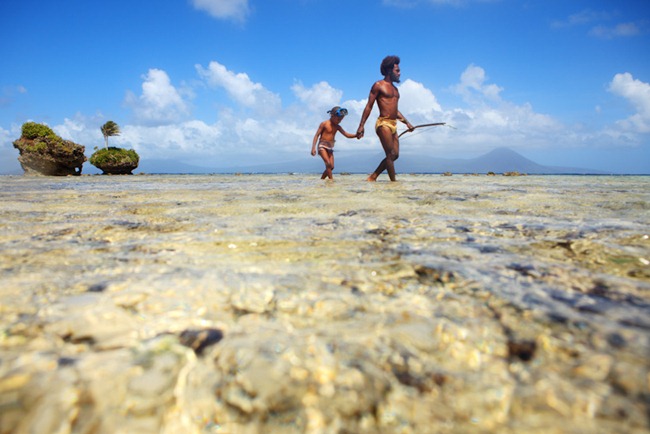
Another image of Bob and his son Jeff. I wanted to include this one here just to emphasize the incredibly clear water around the reef. I’d dreamt about being in places like this for a looong time, now I feel like I’m getting a little spoilt.
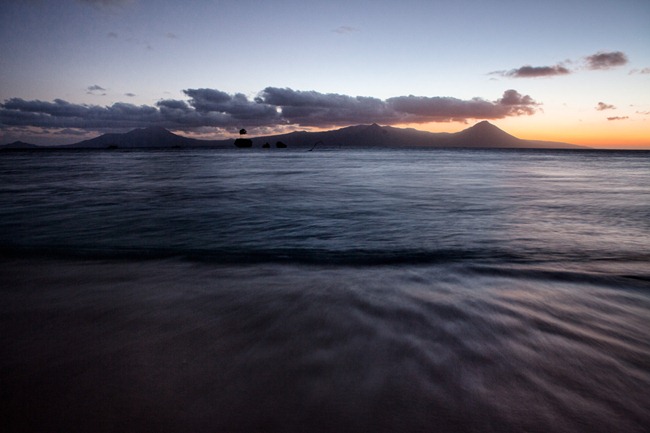
The view out the front of the bungalow, just after sunset. Like I said, I’m a sucker for sea and mountains.

Dimitry (front) is one of Father Luke’s grandchildren. The kid is a CHARACTER, that’s for sure. He’s only four, but he’s very savvy, Tanya had to work real hard to become his buddy, he’s the type of kid who you have to constantly attract with something interesting. Dimitry is also unusually interested in his tradition (for a small child) he always tries to perform the island’s famous snake dance with the bigger boys and has a great sense of hearing.

Franklin is a master wood carver, he creates some true masterpieces. Interestingly though, while Franklin learned the technique of wood-carving from his father, he learned how to carve more complex traditional works from photographs taken in a Museum of Pacific Arts somewhere in Europe. His ancestors sold a lot of the carvings to Europeans over a century ago and even the elders in his village (on Mota Lava) had never seen the carvings in the photographs.
Through a strange twist of fate, the “white men” who laid path for the destruction of the culture of the inhabitants of Rah and Mota islands over a hundred years ago also managed to save a part of it and to indirectly help revive the same part of that culture many decades later.
Franklin is a fascinating man and not only because of his determined approach towards wood-caring, it wasn’t unusual for him to go through five pieces of wood before getting things just right. Franklin is also a field worker of Vanuatu’s cultural centre, which means that he studies and records his own culture. Had I had more time I would have gladly spent hours chatting to the man, asking him endless questions.
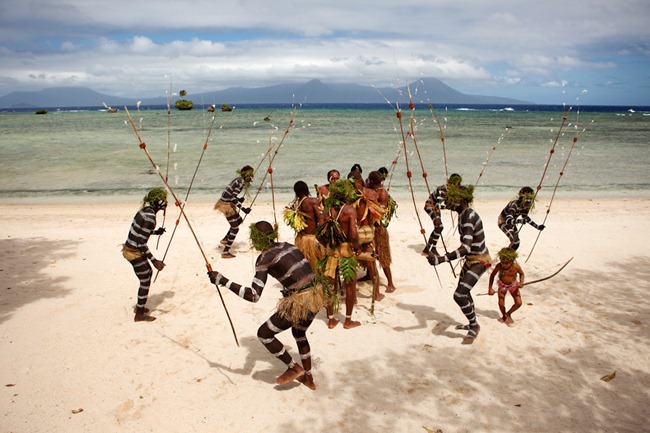
The snake dance of Rah has become famous all over Vanuatu. It is usually performed at weddings and special occasions, but these days it’s become a regular performance for tourists too. I have to say that usually I think stuff like that is lame, but I’ve reconsidered that approach in Vanuatu and particularly with the snake dance. We watched it about 4 times and every time it was pretty cool.
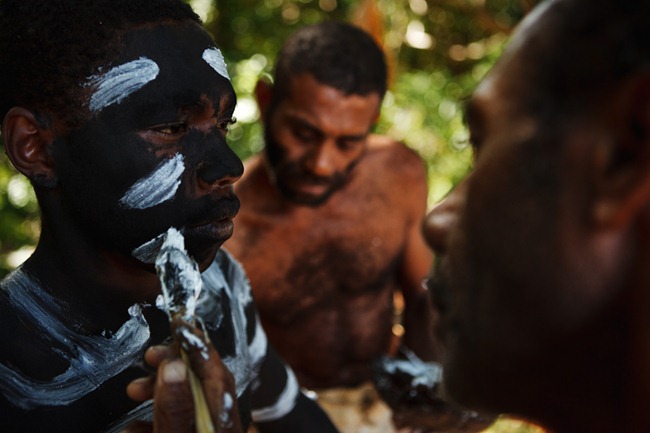
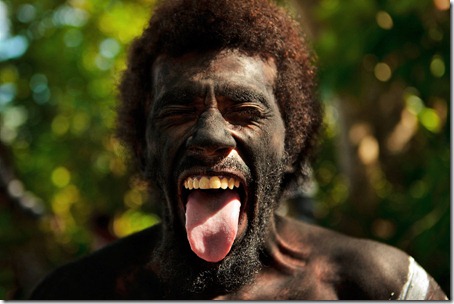
A dancer having his body and face painted for the snake dance. I don’t know if anyone who is not part of the dance group has been behind the scenes for this dance before, back in the day seeing the preparation was strictly taboo. The paint used, as well as the material of the costumes were the performers’ secret and if anyone were to find out that secret they may have very well been killed, such was the kastom law.
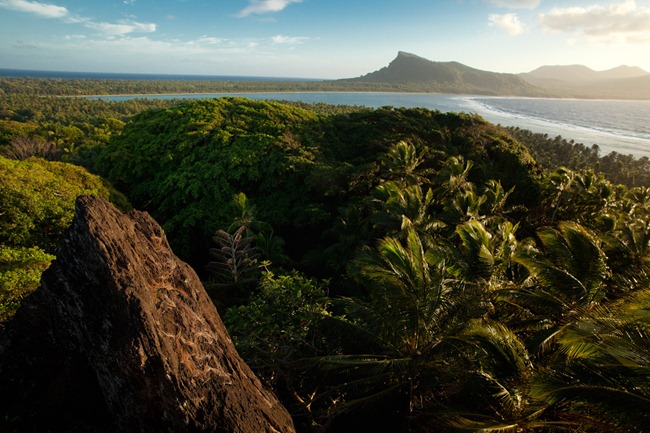
A view from the rock of Rah, one of the most accessible high view points I’ve ever come across (you can get there in about 10 minutes from the village). No photograph will do it justice. From the rock you have a 360 degree of the surroundings and they are magnificent.

I couldn’t resist including another shot of children in a canoe in the lagoon. That place was ideal for photography – dramatic mountain backdrop on one side and the setting sun on the other, doesn’t get much better than that.
That’s all for now folks.

The rhythm of life and the rhythm at which I’ve been shooting in Vanuatu has been completely different when compared to most of the places in which I’ve photographed. It’s probably closest to (my home country) Belarus, because everyday I usually only get to shoot a few images and deal with just one or two people. What this also means, as it did in Belarus is that I get to make more meaningful relationships, even friendships with those who I photograph. Bob, the man in the shot above is one of such new friends.
As I’ve mentioned in the last post, I’ve decided to volunteer my photographic services to some local folks interested in developing tourism in their regions. The first was George and the community in Southwest Bay, Malekula. The next was Father Luke Dini (more on him in a future post) and his community of Rah Island in the remote Banks Islands group. As was the case in Southwest Bay, taking these sorts of “promotional” shots (highlighting some of the culture and the natural beauty of the region) is an excuse to get into some great photo opportunities. You get to see people in their traditional costumes (something you mostly only see in festivals, dances or special occasions) observe what they do day to day and basically you can be a kid and play around with photography.
Back to Bob. If this whole thing was indeed one big chance to play, then Bob was the perfect “play partner”. The man pretty much matched my enthusiasm to make photos with his enthusiasm to take part in them. Get on top of a dangerous, narrow rock? No problem! (see top shot) Go spear fishing? Easy! Climb up a banyan tree? How high? That was Bob’s approach.
Since our first shoot, Bob and I have been having small kava nights, along with Young (the bungalow owner’s son and another great new friend) and some other boys. It is during kava drinking that a foreigner in Vanuatu has a chance to really get to know the locals. I suppose it’s a little like going to the pub in the West, except there’s no chance of some drunkard coming up and asking “What the f– are you looking at?” to start a fight.
During our kava nights I’ve learned that Bob is a truly fascinating character. He’s an athlete – he runs 100m in 10.97 seconds (despite smoking), he’s active in all sorts of cultural activities (because he loves his culture), he’s travelled around Vanuatu more than most of his fellow villagers, oh and he’s a shaman healer. The latter is the reason for why he travels so much. Magic (good and bad) is something that’s considered very real in Vanuatu and Bob’s job is to lift curses as well as cure people that have been affected by the bad (black) magic. He does this with the help of special plants and a little magic of his own. I can’t testify whether there’s any truth to any of the magic business, but the stuff sure makes for great stories by the evening bonfire on the beach, where we drink the kava. Anyway, to the photos.

When I was younger (and cared more) physical prowess and general machismo was a big part of my life. At school we’d compete to see who has the best body, who jumps the highest, who’s the strongest etc. A lot of the men in Vanuatu would put most of us folks from the so-called developed world to shame (even ones who think they are something special). Bob is probably the best example of one of these “hyper-masculine” men. The dude climbs trees better than a monkey, (as I mentioned) runs like a leopard, swims like a fish and he’s built like a freakin Greek statue. Sometimes hanging out with someone like that makes you feel rather inferior. Well, if I have a son one day, I’ll make sure that he can climb trees like Bob. 🙂

The men of Rah Island (and boys) are experts at something that you’re not likely to see in too many parts of the world. When the tide is low, the crystal clear water around the reef allows them to see the fish and to shoot them with the same kind of bow and arrow that they hunt bats and birds with. One of the festivals on Rah Island includes this kind of traditional “fishing” competition, where a whole bunch of fish are rounded up with a long net and the competitors shoot as many as they can.
The little dude in this image is Bob’s son – Jeff. He seemed like such a quiet boy when I first met him. Boy was I wrong. Well, he is quiet in the sense that he doesn’t talk too much, but the kid is a bundle of energy. At 5 years of age he climbs coconut trees just like his dad, runs around like crazy and spits small berries from bamboo tubes at passing birds and bats. Quite a character.

There are deeper parts around the reef and in those places the men dive with the good, old “lastic” (the rubber and wood underwater gun). Here I went down a couple of meters to follow Bob, as he turned over stones behind which the fish might have been hiding.

Unlucky day for one fish. Bob swims towards the surface with his catch.

When the tide is high, it’s usually time to take out the canoe. The sea was pretty rough on the day of this shoot and I could only get this particular shot from a spot where my feet could still touch the ground. As I had hoped, the Aquatech housing has opened up a whole lot of opportunities shooting around water. Without it I would have been really limited and would be kicking myself in these situations. More images around water to come soon. That’s all for now though.
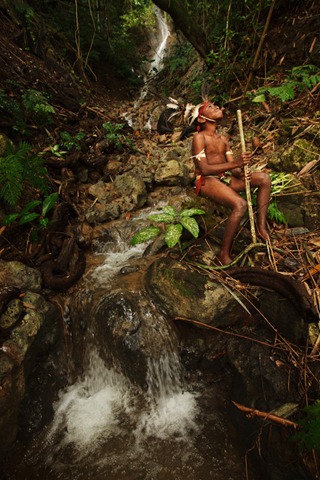
A few posts ago I mentioned that I got involved in helping some locals with the promotion of their regions as tourism destinations through my photographs. In fact I not only ended up doing the photos, but also dished out quite a lot of advice, since the people on most islands of Vanuatu (besides two main ones – Vila and Santo), well they don’t have much of an idea of what foreigners actually want and their misconceptions could not be further from the truth. That is of course very understandable, since their culture and general approach to life could not be much more different from that of “white people” or most foreigners in general.
For the moment and likely for at least five years or more, most of outer islands of Vanuatu (as all the islands outside of Efate where the capital is located are called) are pretty darn far from being “real” tourist destinations. I mean this in the sense that they are not particularly suitable for those who want to relax in comfort, eat well, drink or party. Outside of about three major towns, there’s no electricity, running water is very uncommon and perhaps the most painful thing, at least for me, is that the locals, for most part could not care less about what they eat. There’s no food culture, which equals to no tasty local cuisine as you get in most places around Asia or elsewhere where there is a food culture.
All the minuses aside, Vanuatu offers something that few places offer these days and that is untouched, pristine and absolutely stunning nature. On top of that the people (the Ni-Vanutatu or Ni-Vans, as they call themselves) are some of the most charismatic, friendly and likeable on the planet. There’s also no hassle, no one attempts to sell you crap that you don’t need, no one tries to trick you or rip you off. As much as I love places like India, Nepal and Indonesia, it gets pretty annoying when people constantly see you as a money bag and come up with the most ridiculously creative ways of making you part with your money. You just don’t have that in Vanuatu, at least not yet.
Besides the already mentioned virtues, there’s of course the culture. As I also mentioned in a past post, the culture is undeniably disappearing, but it hasn’t disappeared yet, at least not everywhere. And while there are still places where you can experience this incredible culture in at least some shape or form, you have to go. In some very strange way it appears that the foreign interest in the culture of Vanuatu’s islands has made a lot of Ni-Vans realize just how precious their culture is. At the end of the day, it may very well be tourism which will help ensure that not all is completely lost.
But let me now get specifically to South West Bay. It is one of two regions which I photographed with the aim of helping promote it. As you might have already gathered I am also ready to promote it through my blog and the internet in general, but that doesn’t mean that I’m simply going to sugar-coat everything. I’ll tell the truth, and in this case the truth is good enough to get people to come.
My idea to do this little project came after I met a good man by the name of George Thompson. George was born and grew up in the very remote South West Bay, Malekula. Through some visionary thoughts, hard work and twists of fate he was able to become the leading tour operator and the head of the tourism department in his region. This role even gave George an opportunity to travel to Europe for a tourism expo in the late nineties. He saw places that very few Ni-Vans get to see – France, Germany, Denmark. While he loved the experience, travelling abroad made him realize that things back home were not as bad as some of his fellow countrymen had imagined. Sure, Vanuatu is a poor country by Western standards, but paradoxically there are no homeless people and no one begs for money or food. On top of that the air is fresh and the culture is rich.
When George got back, he had become even more inspired and passionate about showing off his region to the occasional tourists. By 2000 things were looking good, tourist numbers were slowly growing and the income that tourism provided made people’s lives just a little easier. However, things in Vanuatu can change rather quickly. Corruption and “mismanagement” of funds at the higher level are common and around 2004 the nationwide tourism company “Island Safaris” the branch of which George led successfully in South West Bay went down due to “mismanagement”. Tourism numbers started to decline faster than they rose, without the support of a bigger company there was no way that George or the locals could market their region to the outside world. To add even more pain to the dilemma, the airport of South West Bay was sporadically closing and opening, thus making it harder for anyone to get to the area. In a couple of years there were virtually no tourists visiting South West Bay.
Because of George’s past friendships and connections he was able to get a good job, managing a small resort in Port Villa. He had a relatively easy life and a high salary, by Vanuatu standards. George worked at the resort for a couple of years, but soon he became haunted by the thoughts of home. He was away from his family and he knew that while he was having it easy, the people of South West Bay were struggling. He felt pain and guilt and before long he got back to South West Bay with the hopes of reviving the small, but once stable tourism industry that he helped build.
Fast forward to 2010 and things are not looking so bright. Over the past few years tourism has still been near non-existent. Instead of helping bring up the lifestyle of others, George found himself in a similar situation as them. He didn’t tell me his story when I met him, he’s not the kind of person to whine or complain about life, that doesn’t seem to be part of the Ni-Van mentality in general. Instead I got all of this information out of him during the two weeks that I spent in the area, this of course made me even more motivated to help the man in at least some way.
The particular idea about me making some photos came after George showed me some of the past photos of the places in his region sent to him by tourists. According to his stories, the places were beautiful and the people in those places fascinating and so when I saw images that were let’s say not very inspiring I felt a little uninspired myself. I know that I’m not the only one who gets excited about a place by seeing a single beautiful image of it and so with that thought in mind I suggested that we create a little tourism marketing campaign. The campaign would be a combination of documentary images of some of the more photogenic activities, places in the region, as well as some set up shots of the locals dressed in their traditional costumes in their beautiful surroundings.
For me personally the shoots were a reward in themselves. I have been shooting documentary stuff for years and I’m always interested to be placed into new photogenic situations. As far as the set up shots, it was in a sense even more fun to do them. I’d made a couple of short fiction films while at uni and photo shoots of this sort, while fairly new to me were in a some ways similar to making short films. In this case you could say that the shoots were a blend of fiction and documentary (the line was very thin). Our “actors” had to be themselves, they simply had to be in specific locations, wearing costumes which they used to wear in the past and still wear during celebrations or as was customary for the chiefs and some village members while greeting visitors (i.e. tourists). The dances, which are a big thing in the region are performed in similar outfits, (usually more elaborate) so all in all the images we created showed what was most visually exciting about the region of South West Bay and something that the visitors would get a chance to see themselves.
And so let me get to the photos. This is a just a portion of the images I created, you can see more HERE and in the coming months. The image at the top is of one of the boys (Pillison was his name) who I had seen performing the kastom dance at a pig killing ceremony a couple of days earlier. I wanted to photograph him in a similar costume in front of the waterfall, one of the hidden little gems of the area.

Pillison was a great model so we got him and his little mate into a canoe and asked them to row along the shoreline a little. For full impact, I expect this or a variation of this image to be shown in a bigger medium than the 450 pixel photo on a blog. You can get a better view by clicking on the image (to make it larger). Mountains and sea always look dramatic to me and more so when they’re bigger.

This is Chief Ayar again. I blogged about him HERE. I took quite a few shots of this fascinating man. I expect that some of them will be used in something like a brochure, while I’d like to use others, like this one along with images that make up a story, which, if things work out will hopefully appear in some of Vanuatu’s tourism magazines.

A moment from the pig-killing ceremony. During my stay in South West Bay, two chiefs “upgraded” their ranks. Two pigs were killed and meat was shared with the villagers.

Every pig killing is preceded by a traditional or kastom dance. Only certain individuals are allowed to take part. The young are once again being taught the steps of the dances as part of a cultural revival in South West Bay.

For those who like hiking, there’s a fascinating hike to the creepy ancient burial site in the hills above the village of Melmes. The guide, a young chief by the name of John was very passionate in telling us about the history of his people. Below those skulls is a mass burial hole, but before the bodies were placed there they were put onto a high rock. Because John’s tribe thought that they descended from the eagle, they had a little custom associated with this bird. They believed that if the eagle were to eat the eyes of the dead body (when it was placed on the high rock), that person would go directly to paradise, if not, well they go to hell. When I asked John whether many of the dead actually had they’re eyes eaten and went to Paradise, he replied with an uneasy smile – “No, most of our ancestors went to hell.”

Mat-weaving is one of the women’s main occupations. They weave mats for home as well as for sale in big towns like Port Villa in order to generate a small income that usually contributes to the ridiculously high school fees they must pay for their children each year.

Another documentary image taken inside of the village bakery. The baker is cleaning out the ash before putting the bread inside the oven. Once I am home, near a fast connection I’ll try to post some video that I did in this very atmospheric little spot.

George’s uncle is one of the highest chiefs in South West Bay, people like him are an “attraction” in their own right, they are living history and chatting to folks like that is always a highlight of any trip. George’s uncle (his name escapes me, it was a long traditional name, not a Western one) had never had a white man in his house before, so he felt a little nervous when I came to photograph him there. He still had reservations about white people in general because in his youth the presence of a white man was usually bad news. He signed to me that they used to kill the locals by making the cutting of a neck gesture with his hand.
My presence I was sure left him pretty puzzled. I was using the off camera flash in a soft box, which meant that I’d click the button on the camera and the flash would go off (away from the camera). George later confirmed that the flash was indeed a source of bewilderment and amusement as his uncle told fellow elders “This white man came to take my picture. He pressed the button in one place and then this bright light would go off in another place! He’d talk to his woman, she’d press something on the thing that makes the light and then the same thing would happen again, over and over!”

South West Bay is stunningly beautiful. I am not a landscape photographer, but even I was seduced by the scenery of dramatic, red, cliffs and greenery lining the shore. There are much more scenes for the landscape photographer and if I was one of them I’d probably stay even longer.

More beautiful nature (click the image for larger size) and another youngster in a canoe. This is in fact a lagoon about a half hour’s walk from George’s house. Beautiful place, warm people and you only have to dip the net in for a few minutes before you catch fish. Once the traditional owner of this area builds a thatched bungalow, this will be a great place to spend a couple of days.

Just a few hundred meters from the lagoon, you come to this place, which made me feel a little like I was in a forest in Europe. The setting sun made for a perfect lighting scenario and I couldn’t resist making a couple of exposures.
Some final words: For those who are into photography and interested in visiting Vanuatu there are some good news. Through working with me George learned a good bit about what sort of stuff more serious photographers might be interested in. In other words he knows that we don’t like cheesy pictures of kids giving us the thumbs up (very common in Vanuatu) or people standing with their hands by their sides like soldiers before a march. He also understands that sometimes real life is the most fascinating subject of all, so he can help the photographers get access to shoot stuff like that.
I might be doing a workshop in Vanuatu at some stage and if I do there will only ever be one. However for the more independent minded or more advanced photographers, I highly recommend you to get over to South West Bay and to let George show you around. I’ve only scratched the surface here. There’s reportedly a great reef for those who love shooting underwater (I had left my housing near the airport not knowing this) you can go on a wild pig hunt with a couple of dudes with bush knives and a pack of dogs. There are more traditional villages and fascinating elders in the mountains and some folks shoot river fish with bows and arrows.
Oh and did I mention that the whole thing will be extremely affordable, especially by Vanuatu standards? Whatever you pay will go directly to the community, there are no middle-man organizations (as is often the case when you do things through bigger companies). I don’t get anything out of it apart from satisfaction in knowing that I helped someone. I’ll post more on the prices and the possibilities at a later stage, but if anyone is already interested, feel free to contact me via this blog or the email on my website.


 Mitchell's Travel and Photography Blog